Google Ads landing page: structure, example and launch checklist
A Google Ads landing page should continue the promise made in the ad, explain the offer and help the visitor take a clear next step: request a quote, book a call or contact your team. Launch readiness depends on more than the design. The content, mobile experience, form behaviour and delivery of enquiries all need to work together.
A website built for paid traffic can give a business an additional route to customer enquiries. It can explain a service outside opening hours, present relevant work and collect the details a sales team needs. The practical value comes from connecting the advertising message, the page and the response to the customer.
This guide covers landing page structure, an example from AIDENTYKA’s portfolio, development deliverables and a checklist for launch. It also includes a short brief you can copy when commissioning a page for Google Ads or another advertising source.
Do you need a dedicated landing page or an existing service page?
A landing page is the destination someone reaches after clicking an ad. It can be a standalone campaign page, a service page, a catalogue category or a product page. Choose it around the customer’s task.
| What the customer needs | Suitable destination | What supports the next step |
|---|---|---|
| One specific service, such as window replacement | A focused landing page or service page | Scope, examples, service area and a survey request |
| A choice between models or materials | A catalogue category | Specifications and access to advice |
| A product available to buy | A product page | Price, availability, delivery and checkout |
| A supplier for a complex B2B project | A detailed service page on a corporate website | Capabilities, relevant projects, scope and an estimate request |
An existing page may only need improvements if it already matches the offer. When there is no suitable journey, consider landing page design and development for your service. Distinct business services need their own explanation rather than one generic sales message.
Match the ad with the first screen
After clicking, visitors should recognise the service and conditions that attracted them. With Google Ads, start with the search intent: is the person choosing new windows, looking for a repair or arranging installation? Each need calls for different information.
The following is an illustrative copy example for a window replacement company. It is not a quotation from a client project.
| Element | Generic version | More specific version |
|---|---|---|
| Heading | Quality you can trust | Window replacement for homes in your city |
| Explanation | A personal approach | Get help choosing the specification, arranging a survey and defining installation work |
| Button | Learn more | Request an initial estimate |
| Beside the form | Leave your details | Tell us your city, the number of windows and how to contact you. We will clarify the scope for an estimate |
Use the business’s actual location and terms. If there is a survey fee or a charge for travel, explain it before the enquiry. Discounts, specifications and timing should remain consistent between the ad and the page.
Google recommends connecting the landing page with the ad and making the intended action easy to find; see its landing page optimisation guidance. These are useful design principles, not a promise of a particular number of leads.
A landing page structure built around seven buyer questions
For a service that requires an individual estimate, the following sequence is a practical starting point. Adjust it to the product and what customers need to know.
| Section | The visitor’s question | What to include |
|---|---|---|
| First screen | Is this relevant to my task? | Service, audience, service area and primary action |
| Offer details | What will I receive? | Deliverables, options, terms and limitations |
| Pricing explanation | Does it fit my budget? | Current packages or clear estimating factors |
| Evidence | Why trust you with the work? | Real projects, photographs and verified testimonials |
| Process | What happens after I enquire? | Stages, required customer input and approvals |
| FAQs | What important conditions am I missing? | Payment, timing, support and applicable guarantees |
| Contact | How do I start? | A form, booking route or contact with the next step explained |
Repeat the call to action after evidence and towards the end of the page where it is useful. Keep the action consistent: a request for an estimate should not quietly become a paid reservation or a different service.
AIDENTYKA example: the enquiry journey at Goodwin Windows
AIDENTYKA developed the Goodwin Windows and Doors business website and catalogue for the Canadian market. It brings together window and door categories, individual service areas, completed work, FAQs and consultation contacts. This is a multi-page website whose structural principles can inform a campaign landing page.
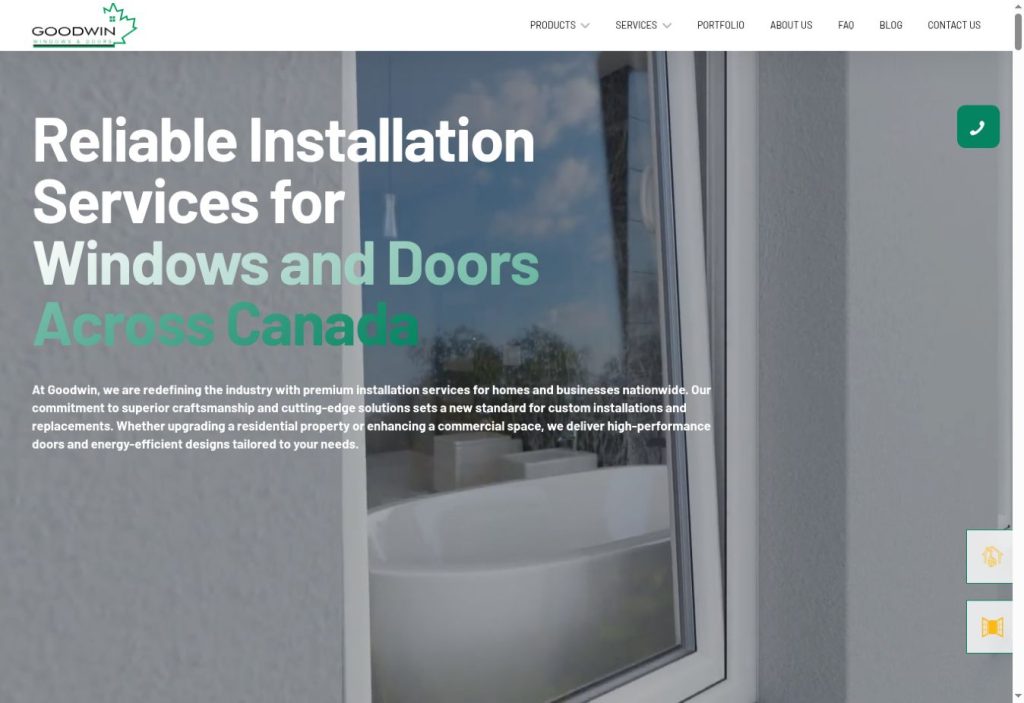
Three decisions are particularly relevant:
- Products and services have separate entry points. Someone choosing new windows and someone seeking a repair can begin in different sections. Each journey can explain the information relevant to that need.
- The catalogue has supporting context and examples. Visitors can identify the right area, look at completed work and prepare questions for a consultation. This gives the sales team a more specific starting point for the conversation.
- Contact follows the selection process. After exploring a product or service, the visitor can discuss their property and the required solution with the company.
For an advertising campaign, we would apply the same principle: a repair ad would lead to repair information, relevant examples and an enquiry route; an ad for new windows would lead to the appropriate product or service area. This is a recommendation for using the structure, not a report on Goodwin’s advertising campaigns.
The delivered website lets the business present its range and services separately and accept consultation enquiries. The published case documents the structure and features; it does not report advertising conversion figures. Explore the full Goodwin Windows case study.
What an AIDENTYKA landing page project can include
Our landing page development service sets out an example scope. We agree on sections, features and content responsibilities for the actual project. Each stage should produce something the client can review.
| Stage | Client deliverable | How to check it |
|---|---|---|
| Structure and prototype | Section order, offer content and enquiry journey | The audience, offer and intended action are clear |
| Design | Approved phone, tablet and desktop layouts | Content is readable, actions visible and form states planned |
| Development | Working page with the agreed form or contact route | Fields, errors, confirmation and enquiry delivery work |
| Search preparation | Headings, description, URL and indexability decision | Settings match the page’s purpose and are checked after launch |
| Measurement | Agreed events that can be observed technically | Contact clicks remain separate from confirmed enquiries |
| Launch and handover | Domain, HTTPS and link checks, access and instructions | The owner can use the agreed content-management features |
Copywriting, translation, calculators, payments and CRM connections are scoped separately. We choose a CMS, framework or custom implementation around the required features, editing needs and future development.
What determines landing page cost and delivery time?
A page with finished copy and a straightforward form is a different project from a bilingual page with a calculator and CRM integration. The estimate depends on:
- Materials: copy, photographs, project examples and confirmed business terms.
- Features: forms, file uploads, appointments, payment or external systems.
- Design: unique sections, animation and custom interactions.
- Languages and approvals: translation, content review, decision-makers and feedback dates.
A proposal should distinguish structure and design, development, content, integrations and launch. Domain, hosting and third-party licence costs should be visible separately. Agree on a schedule after reviewing the brief, with milestones and dependencies as well as a final date.
For a fuller explanation, read our guide to website development scope and cost.
Getting clicks but no leads: what to investigate first
The same symptom can have several causes. Use this table to form a hypothesis and choose the next check, then assess the actual page and traffic before drawing conclusions.
| What you observe | What to investigate | Next check |
|---|---|---|
| Visits but few contact actions | The match between search, ad and offer | Compare search terms and creative with the first screen |
| Forms started but not completed | Fields, validation, mobile keyboard and conditions | Complete the form on a phone, including error states |
| Buttons clicked but nothing reaches the team | Submission outcome and delivery destination | Check confirmation and receipt of a test enquiry |
| Enough enquiries, but poor relevance | Location, budget expectations and offer | Clarify targeting, terms and requested details |
| Suitable enquiries but no sales | The response and follow-up process | Review the journey after the lead reaches the team |
The website helps collect and clarify demand. Advertising quality, a competitive offer and sales follow-up remain parts of the same process.
Measure received enquiries separately from button clicks
Agree on four distinct stages: contact click, confirmed enquiry, qualified lead and sale. Pressing a form button does not establish that submission succeeded. Opening a Telegram chat does not establish that the person sent a message.
Illustrative example, not a result from our portfolio: 500 sessions produce 40 contact clicks, but only 10 sessions include a received enquiry. The team considers four enquiries relevant. The share of sessions with an enquiry is 10 / 500 × 100 = 2%. Reporting only the 40 clicks obscures how many enquiries actually arrived.
Tie a successful-enquiry event to a confirmed submission outcome and check duplicate counting. Where message receipt cannot be passed from a messenger to analytics, the team needs a separate record of enquiries received. Do not send customers’ personal contact information to Google Analytics; see Google’s guidance on personally identifiable information.
Google Ads landing page checklist before launch
- Offer: the service, location, pricing and promotional terms match the ad.
- Destination: the final URL works with campaign parameters, and redirects reach the intended page.
- First screen: the message is readable before decorative animation finishes, and the next step is clear.
- Mobile layout: navigation, text and buttons fit the screen; the keyboard does not prevent form completion.
- Form errors: invalid fields have useful explanations, and entered information is not unnecessarily lost.
- Successful enquiry: the visitor sees confirmation and the test enquiry reaches the agreed recipient.
- Contacts and languages: phone, email and messenger details are correct; language controls open the equivalent page.
- Evidence: photographs represent the service, testimonials are genuine and important conditions are accessible.
- Loading: images do not unnecessarily delay the offer, and forms and buttons remain stable as the page loads.
- Measurement and access: events represent the agreed actions, and the page is available to users and the advertising crawler.
Check phones, computers and the in-app browser your audience will use. Google Ads destination requirements include functionality and accessibility of the destination. This checklist does not replace a review of other applicable advertising policies.
Can a campaign landing page also attract organic search traffic?
Yes, if it serves a specific search intent, contains a useful standalone offer and is available for indexing. A service page needs clear headings, substantive content, examples and relevant internal links. Buying traffic does not itself establish organic rankings.
Different services may need several substantial pages. For near-identical advertising variants, decide on the main URL and indexability settings according to their purpose. Avoid automatically blocking all campaign pages from search or multiplying copies without additional value. Google’s SEO Starter Guide explains the foundations.
A short landing page brief you can copy
- Offer: which service or product are we promoting?
- Audience and location: who decides to buy, and where does the business operate?
- Traffic source: Google Ads, social ads or Telegram; an example ad or search query.
- Action: what should the visitor do, and what details does the team need?
- Evidence and content: photographs, case studies, testimonials, copy and current terms.
- Enquiry delivery: who receives the enquiry, where and through which system?
- Features: languages, forms, CRM, payments, calculator and content editing.
- Constraints: preferred launch date, budget guidance and the person responsible for approvals.
For a broader project, use our full website brief. Include your current website if you have one: focused improvements may be sufficient.
Frequently asked questions
Can Google Ads send traffic to my homepage?
Yes, if the homepage matches the advertised offer and supports the intended action. For a particular service, compare it with that service’s own page: where can a buyer find the terms and contact route more easily?
Do Google Ads and social ads need different landing pages?
Not always. A search query often states a need directly, while an ad in a feed or channel may require more context. Compare the audiences, offer and expected action. One page can serve several sources when it meets those expectations.
How much does landing page development cost?
The estimate depends on structure, content, languages, design and integrations. Start with an offer description, an example ad and the desired action. A final quote should identify the agreed scope, additional costs and how changes will be handled.
Does this require a complete website redesign?
No. Updating the opening section, adding relevant work, fixing a form or building one service page may be enough. Assess the existing website and campaign requirements before deciding the scope.
Will a new landing page guarantee more leads?
Lead volume also depends on demand, traffic, the offer and sales follow-up. The page should remove barriers to making contact. Compare suitable enquiries received and sales under comparable conditions.
Prepare your website for the offer you want to advertise
AIDENTYKA can help establish whether you need a dedicated landing page, a new service page or improvements to an existing website. We start with structure and the enquiry journey, agree on the design, build the required features and check them before launch.
Send a description of your service, an example advertising offer and your current website if you have one. Discuss landing page development. If you first need to identify weaknesses in an existing page, start with a website audit.