Website redesign for business: when you need it and how to protect SEO
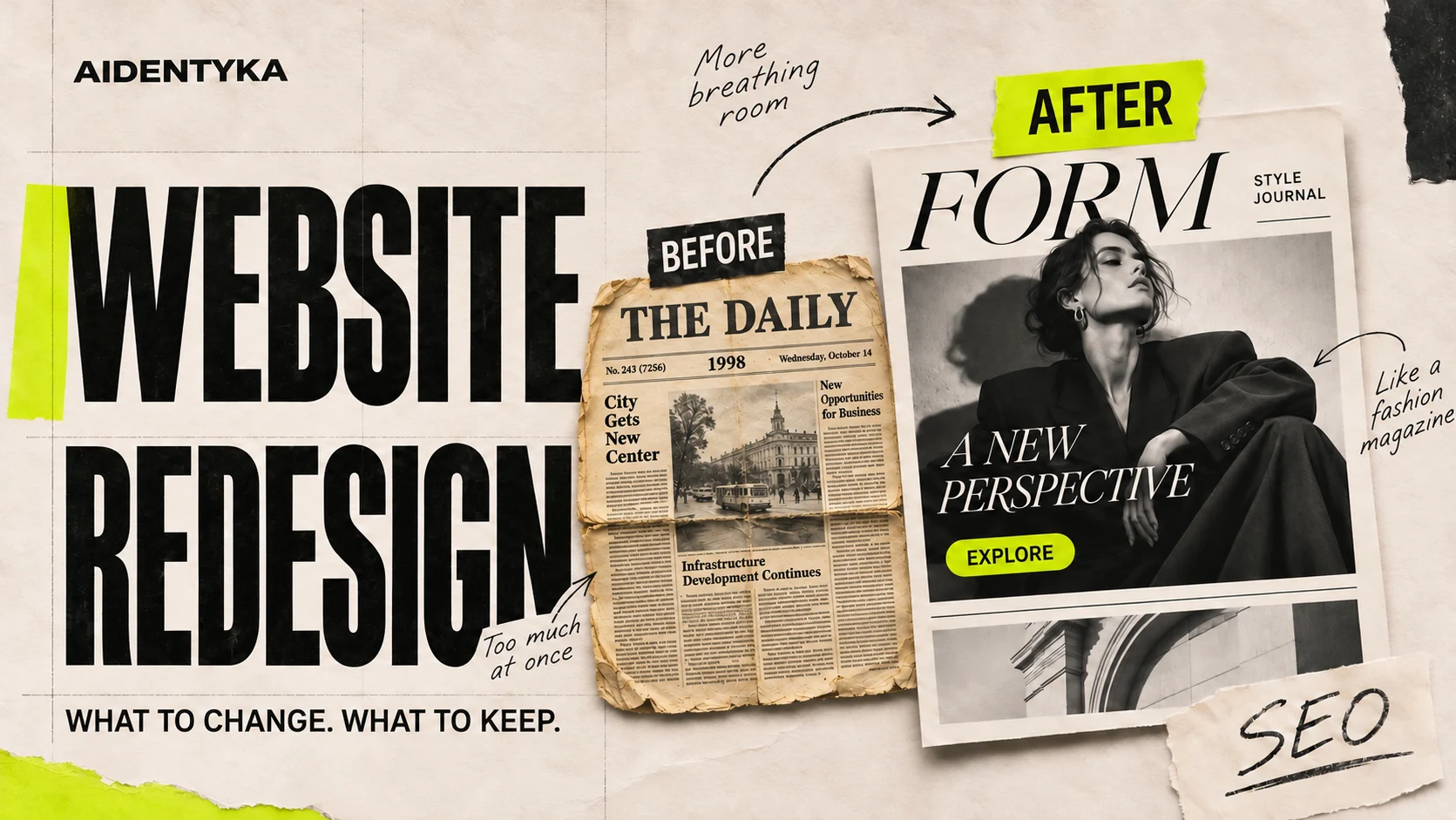
A website redesign updates your structure, design and user journeys to meet current business needs. It becomes useful when the existing site makes it difficult to understand your offer, assess your experience or get in touch. To reduce SEO risk, record valuable pages and search performance before making changes, then check URLs, content and functionality before launch.
Your website can be an additional source of leads from Google, advertising and referrals. When a visitor finds an outdated offer, cannot locate the right service or struggles to send an enquiry from a phone, some of that potential is lost. A redesign should remove those obstacles and give your team a clear way to evaluate the outcome.
This guide explains when targeted improvements are enough, what belongs in a full website redesign and how to prepare the launch. Rankings cannot be guaranteed: SEO preparation is about reducing risk and spotting problems early.
When does a business need a website redesign?
Age alone does not determine whether a website needs rebuilding. First assess how well it supports your current offer and sales process. These situations are useful starting points for an audit.
- Your services or audience have changed. You now sell comprehensive solutions, but the website still presents an old list of individual tasks. Your sales team has to explain the offer again.
- Visitors struggle to choose. Several services share one long section without specific terms, relevant examples or a clear next step.
- The mobile experience gets in the way. Navigation covers the content, fields are awkward, a button opens the wrong contact or the page responds slowly.
- Updating the site is difficult. Publishing a case study or adding a service requires complicated manual changes each time.
- You receive traffic but few suitable enquiries. Investigate the offer, acquisition sources and contact journey. That observation alone does not establish that a new design is needed.
A useful exercise is to ask someone unfamiliar with your business to find a specific service, an example of your work and a way to request an estimate. Record where they need help. Those observations can become concrete tasks for a website redesign.
Targeted improvements, a visual refresh or a complete redesign?
Match the scale of the change to the problem. If visitors can find the right pages and enquiries arrive regularly, replacing the whole website may be unnecessary.
- Targeted improvements. Suitable when the structure works and the problem is local: an unclear description, a broken form, a missing case study or a heavy image. The deliverable is a specific set of fixes on existing pages.
- An interface refresh. Appropriate when the offer and structure remain relevant, but readability, mobile navigation and visual consistency need attention.
- A full redesign. Worth considering when services, catalogue logic, page roles or key integrations change. The scope includes structure, prototypes, design, implementation and migration checks.
Assess a platform change separately. Functionality or maintenance limitations may justify it, but changing technology is not a requirement of redesign. Choose the stack around the business requirements, integrations and resources available to maintain it. We take the same approach to business website development.
What to record before designing the first screen
Establish a baseline before starting. Without one, it is difficult to separate the effect of the redesign from seasonality, advertising changes or the sales team’s activity.
- Pages receiving organic search visits and the queries associated with them.
- Services and pages that lead to relevant enquiries.
- URLs used in advertising, partner publications and important external links.
- Copy, photographs, case studies and documents that remain useful.
- Current contact routes, the people responsible for responding and your definition of a successful enquiry.
- A backup, an access inventory and a plan for restoring the previous version if a critical problem occurs.
For a business with limited traffic, conversations with the sales team are particularly useful. What do customers repeatedly ask? Which documents do they request? What stops them proceeding? The website can answer some of those questions before the first conversation.
How a redesign can support more relevant enquiries
Start with a specific journey: someone looks for a solution, opens the relevant page, reviews the terms and evidence, then sends an enquiry. Identify the information they need at each step.
For example, a renovation company may describe all its services on the homepage. A revised structure could separate residential and commercial projects, show relevant work and explain the information needed for an estimate. This is an illustrative scenario, not a report of a particular client’s results.
Beside a service description, “Discuss your project” can be more informative than a generic “Contact us”. Explain what the visitor should send, such as property type, size and intended scope. The team receives useful context, while the prospective client knows how to begin.
Explore AIDENTYKA case studies for examples of website structures across business sectors. Our article on websites for service businesses looks more closely at the journey from interest to enquiry.
How to reduce SEO risk during a website redesign
List important URLs and decide whether each page should remain, be updated, be consolidated or be removed. If addresses change, map old pages to their new equivalents. Google notes that major changes can cause temporary visibility fluctuations. See its site migration guidance.
For a permanent address change, configure a server-side 301 or 308 redirect to a relevant destination. Test where it ends and avoid unnecessary redirect chains. Google explains the options in its redirect documentation.
Review canonical tags, which identify the preferred URL for a page. They should align with the chosen URL structure, and internal links should use those preferred addresses. Remove references to the test domain. Google’s canonical URL guidance explains the principles.
For Ukrainian and English versions, check translation pairs and hreflang: each language page should reference the corresponding alternatives, including itself. The language switcher should open the translation of the current page too. Refer to Google’s localized pages documentation.
Update the sitemap and verify that important pages are available for indexing. Temporary restrictions used during development must not remain on the public version. A sitemap helps search engines discover URLs but does not guarantee indexing, as explained in Google’s sitemap guidance.
What should a website redesign service include?
Agree the deliverable for each stage so that “update the website” means a defined scope. For a business with several services, a practical starting point is:
- Audit and priorities: evidence, problems, business goals and an agreed list of changes.
- Structure and prototypes: pages, navigation, content order and enquiry journeys.
- Design: key desktop and mobile templates, plus menu, button and form states.
- Development: responsive implementation, editing tools and agreed integrations.
- Migration: content, media, language versions and a plan for existing URLs.
- Testing and handover: verified journeys, access details, instructions and support arrangements.
Specify who prepares copy, translations, photography and legal documents. If these are client inputs, include them in the plan with named owners. That helps avoid completing designs which cannot be populated with the material needed to launch.
What affects website redesign cost and delivery time?
The number of unique templates matters as well as the total page count. Ten service pages sharing a structure require a different amount of work from ten distinct interactive sections.
Other factors include the condition of the existing code, languages, content migration, integrations, customer accounts, catalogue features, copy preparation and SEO checks. Timing also depends on those tasks and how quickly the team can review and approve materials.
To compare proposals, request the same list of deliverables: which pages and interface states are designed, what gets migrated, who handles redirects, how enquiries are tested and what happens after launch. You will then be comparing similar scopes.
Prepare a short website development or redesign brief. Your current site, priority services and a list of problems provide more useful estimating information than a visual reference alone.
A checklist before launching the redesigned website
- A visitor can find a service, review relevant work and start an enquiry on mobile and desktop.
- Menus, buttons, language switching, forms and error messages work in the agreed browsers.
- A test enquiry actually reaches the responsible person and is distinguished from real leads.
- Valuable pages and required redirects have been checked against the inventory.
- Copy, prices, contacts and cover-image languages match their pages.
- Loading performance, layout stability and content accessibility have been checked.
- Someone owns the launch, monitoring and restoration of the previous version if necessary.
For loading experience, Core Web Vitals are useful: LCP, INP and CLS describe main-content loading, responsiveness and visual stability. Test real user journeys as well. A performance score alone does not tell you whether an enquiry reached the team.
How to measure the result after a redesign
In the first few days, focus on operation: page availability, errors, enquiry delivery and analytics accuracy. Then compare periods of equal length, accounting for seasonality and advertising budget changes.
Review Google impressions and clicks, visits to priority services, enquiries received and the proportion that match your offer. Clicking Telegram indicates an intention to start a conversation; a message actually received is a later stage. More clicks on a contact link do not necessarily mean more sales.
Agree in advance what a useful outcome would look like: more requests for a priority service, fewer unsuitable enquiries or simpler catalogue updates. Drawing conclusions requires enough data and time for your sales cycle to run.
Frequently asked questions about website redesign
Do we have to change every page?
No. Pages that reflect your current offer and perform their role can remain. Use an audit to decide the scope; useful content and sections do not need removing simply to create a different appearance.
Can we keep our domain and current platform?
Yes, if they support the required features and maintenance. Redesign does not automatically require a new domain or technology. Assess the limitations before deciding to migrate.
Does redesign guarantee more leads?
No. It can remove obstacles to making an enquiry, but demand, traffic quality, your offer and sales follow-up also affect results. Measure relevant enquiries actually received.
Will the existing website remain available during development?
Usually the new version can be prepared separately while the live site continues operating. Agree the switch-over process, backups and any possible interruption according to the technical architecture.
Where should we start if the scope is unclear?
List business goals and user problems, then audit the site. This helps identify improvements that can come first and whether a complete redesign is justified.
Let’s discuss what your website needs
Send AIDENTYKA your current website and a short explanation of the services you want to promote and what gets in the way of enquiries. We can discuss the changes, scope and launch process.
Start with a website audit or discuss your redesign on Telegram. If you are ready for a full update, explore AIDENTYKA’s website redesign service.